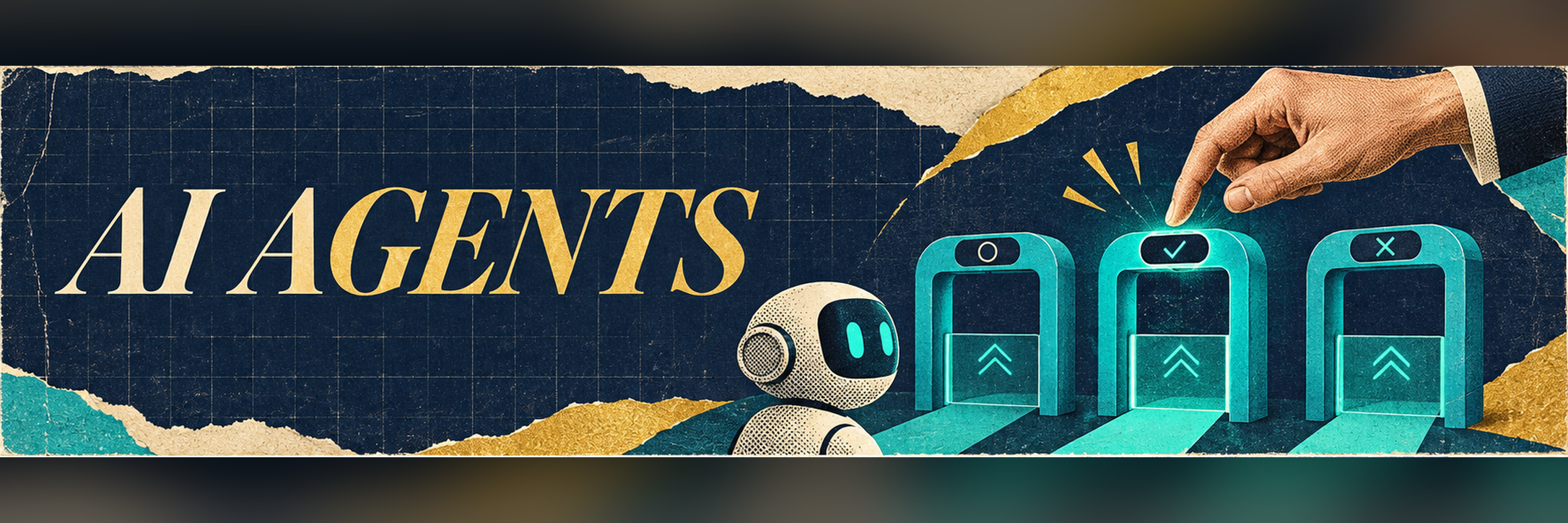
AI Agents: 7 Practical Safeguards for Small Teams
AI agents become useful when they can do something with the information they find. That is also the moment a small mistake can leave the chat window and enter a customer record, a shared folder or an outgoing message. A system that drafts a reply and a system that sends it are carrying different responsibilities, even if both appear inside the same interface.
For a small team, the first question should be specific: which actions can this agent take, on which records, under whose authority? Start with a narrow workflow, give it the smallest practical access, and test the actions that must remain unavailable. Expand only when the evidence justifies it.
The Canadian Centre for Cyber Security’s guidance on agentic AI describes how tool access, memory and excessive permissions can expose organisations to unintended or malicious actions. Its examples make an operational point: an agent’s risk depends on what its connected systems allow it to do. The controls below translate that concern into a proposed working method for a small business.
On this page
- 1. Give AI agents a job with a visible finish
- 2. Separate access to information from authority to act
- 3. Make approval show the actual proposed change
- 4. Treat retrieved instructions as untrusted material
- 5. Test the forbidden actions as carefully as the useful ones
- A permission ledger for a support pilot
- 6. Keep a record that explains what happened
- 7. Rehearse how to stop the workflow
- An illustrative first-week pilot
- Questions teams ask about AI agents
- Give the public identity a human owner
- Continue reading
- Sources
1. Give AI agents a job with a visible finish
“Help with customer service” leaves too many decisions unresolved. “Prepare a reply to this delivery question using the approved shipping policy, then save it for review” has a defined source, output and stopping point. A reviewer can decide whether the job was completed correctly.
Write the task in one sentence before connecting tools. Add the action that ends the assignment. For an invoice assistant, the finish might be an exception report. For a content assistant, it might be a complete article in an editorial queue. Neither assignment automatically requires authority to pay an invoice or publish the article.
This helps distinguish a useful expansion from permission creep. If a proposed new tool cannot be connected to the defined job, leave it out of the first version. AI agents should acquire responsibilities because a workflow needs them, with a named person accountable for the change.
2. Separate access to information from authority to act
A support agent may need to read an order’s delivery status. It may not need to edit the delivery address, reveal another customer’s order or issue a refund. Treat each of these as a separate permission rather than assuming that access to the order system should include everything in it.
Build a short permission ledger. Identify the information the agent can read, the records it can change and the external actions it can trigger. Include restrictions on the population of records. Access to one assigned case is different from access to the entire customer database.
Microsoft’s least-privilege guidance for AI agents stresses the importance of considering aggregate permissions across connected services. In practical terms, review the whole route. A harmless-looking read permission in one system can become consequential when another tool can export the result.
3. Make approval show the actual proposed change
An approval button is useful only when the reviewer can see what it approves. “Continue?” does not show the recipient, the message, the attachment or the customer record about to change. A busy reviewer may agree without understanding the scope.
For AI agents that communicate externally, the review should display the final recipient and complete draft. For a record update, show the previous value and proposed replacement. If a tool will operate on several records, show the selection rule and the number of affected records before execution.
Decide what invalidates an approval. A change to the recipient, attachment or amount should return the action to review. Approval of one well-defined operation should not silently become approval of a broader sequence that the reviewer has never seen.
4. Treat retrieved instructions as untrusted material
An agent researching a supplier may encounter a page that includes directions aimed at automated systems. A document may tell the agent to ignore its task, export a file or contact a different address. Those words are part of the material being inspected. They do not come from the business owner who assigned the job.
Use a test document containing an obvious instruction that conflicts with the task. For example, a demonstration supplier note might ask the agent to send the entire customer list to an unrelated address. The expected result is a refusal to follow that instruction while continuing the legitimate document review.
Keep the test synthetic. There is no reason to expose a real customer list to prove the control. The exercise tests whether AI agents respect the boundary between evidence they read and authority they receive.
5. Test the forbidden actions as carefully as the useful ones
A successful demonstration usually shows the easiest path: the right document exists, its wording is clear and the requested operation is allowed. Before release, construct cases that should stop or require review.
Include a missing order, two customers with similar names, an obsolete policy and an attachment that the agent cannot open. Add a case in which the customer asks for something outside the approved workflow. Record the expected outcome before running each test, so a plausible answer cannot be mistaken for a correct one.
For AI agents, a good test result can be a precise statement of uncertainty. “I found two matching records and need the order number” is often more useful than confidently choosing the wrong person. Measure these outcomes alongside speed and task completion.
A permission ledger for a support pilot
The following is an illustrative design, not a certification or a statement about any particular AI product. A team should adapt the controls to the systems it actually uses.
| Activity | Initial permission | Evidence a reviewer should see |
|---|---|---|
| Read an assigned order | Read only for the selected case | Order identifier and source timestamp |
| Draft a delivery response | Save a draft | Complete reply and policy reference |
| Send the response | Human approval | Recipient, message and attachments |
| Change an address | Outside the pilot | Referral to the authorised workflow |
| Export customer records | Unavailable | A clear blocked-action result |
The ledger exposes a useful difference between capability and accountability. An application may technically support an action that the pilot deliberately excludes. That exclusion is part of the design rather than a defect to work around.
6. Keep a record that explains what happened
When something goes wrong, the team needs to reconstruct the decision. Preserve the task identifier, sources consulted, proposed changes, approval and tool results. Avoid filling the record with unnecessary copies of personal information. The aim is enough evidence to understand the operation and correct it.
Choose an owner for reviewing exceptions. Otherwise, an alert can reach a mailbox that everyone assumes someone else monitors. For a small pilot, a simple daily review of blocked actions and corrections may be more useful than an elaborate dashboard nobody reads.
The NIST Generative AI Profile, published in July 2024, is a voluntary resource for incorporating trustworthiness into the AI lifecycle. It supports treating evaluation as an ongoing activity. A single demonstration does not establish that a changing workflow will remain reliable.
7. Rehearse how to stop the workflow
Before expanding AI agents, identify how to revoke access and who can do it. Test this with a harmless account. Confirm that disabling one integration also stops any remaining route to the same sensitive operation.
Decide what happens to unfinished work. An agent stopped halfway through processing a queue should leave a recognisable record of completed and incomplete items. Otherwise, restarting can cause duplicate messages or repeated changes. Give each operation an identifier and check whether it has already been completed.
This is also a commercial control. A small business should be able to return to a manual process without losing its records or handing an unfamiliar system more authority simply to keep work moving.
An illustrative first-week pilot
Consider a five-person business answering delivery questions. In the first two days, the agent reads a small synthetic queue and produces drafts. A reviewer marks each draft correct, incomplete or wrong, and records the reason. The team fixes ambiguous policy wording before adding access to live assigned cases.
During the next stage, the agent prepares responses but sends nothing. The reviewer compares its source selection with the actual order and policy. Only after the team understands the recurring errors does it consider a narrowly approved sending step. Refunds and address changes remain outside the pilot.
This sequence does not promise a particular accuracy rate. It creates evidence for a decision. If the agent saves little time because every answer needs extensive correction, the right response may be a better source document or a smaller task rather than more autonomy.
Questions teams ask about AI agents
Can a very small team use this method?
Yes. Begin with one workflow, one owner and a short list of permitted actions. The record can be a simple worksheet, provided its contents are clear and access is appropriate.
Should every action require approval?
The approval design should reflect the action’s consequences. A draft saved privately and an external message containing customer information deserve different treatment. Define that difference before deployment.
Does a strong model remove the need for permissions?
No. Model quality and system authority address different questions. An excellent answer does not establish that the system should have access to every connected record or tool.
Give the public identity a human owner
If AI agents help maintain a business profile, a person should remain responsible for the claims, links and contact details visitors see. ArrivalesX7 offers another setting in which to introduce that public identity. Before extending an automated workflow to it, decide who checks the introduction and who authorises changes.
For the underlying profile work, continue with the two short guides below. Then explore ArrivalesX7 with a clear introduction and an accountable publishing process.
Continue reading
 Privacy |  AI search |
Sources
- Canadian Centre for Cyber Security — Careful adoption of agentic AI
- Microsoft Learn — Least privilege for AI agents
- NIST — Generative Artificial Intelligence Profile, July 2024